Why I Make Music The Way I Do
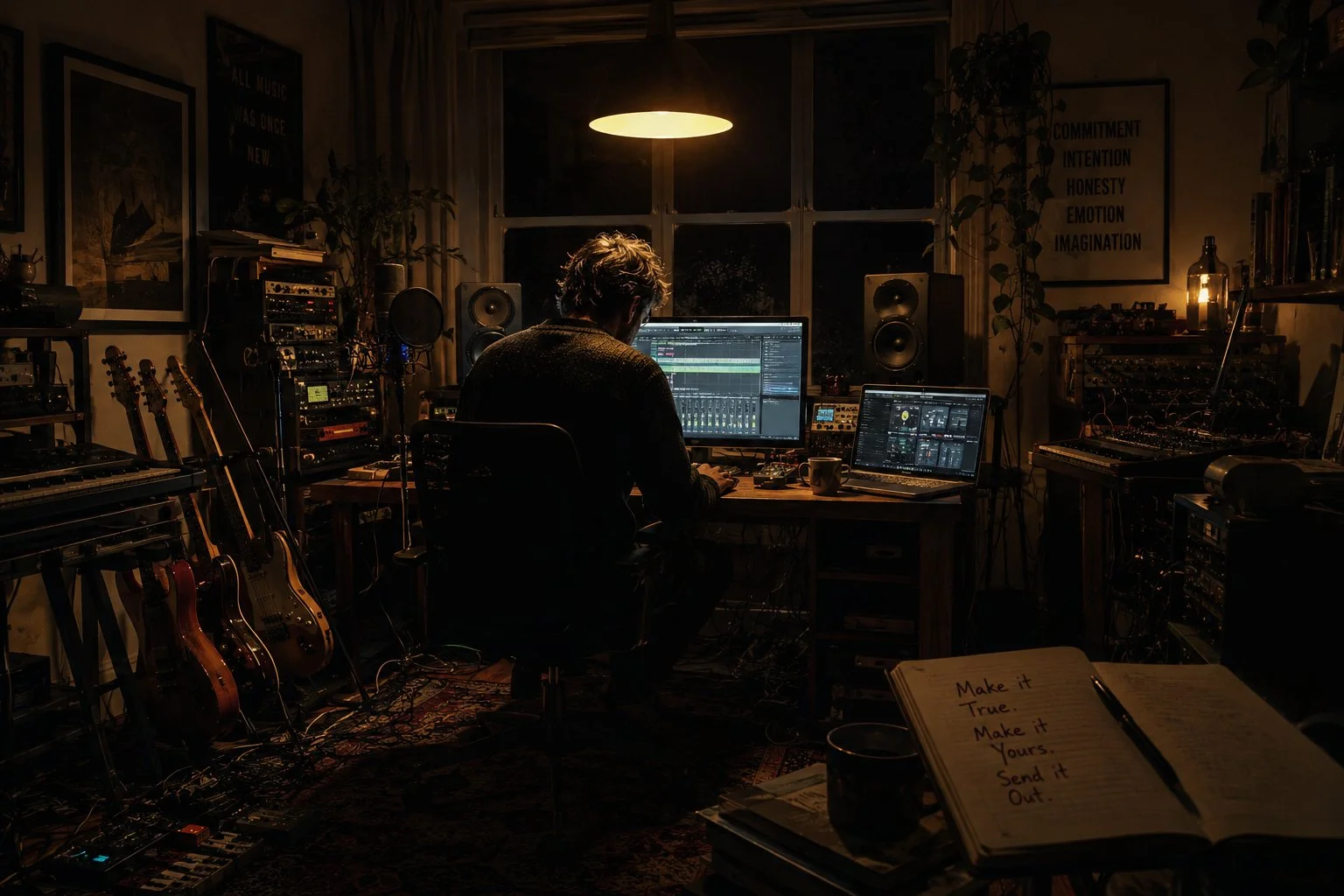
There is a recurring theme in music commentary right now that deserves a direct response. It is usually delivered by men who lived through the height of the commercial record industry, the era of large studios, big budgets, A&R departments, and the romantic dream of being discovered. The argument, stripped of its nostalgic packaging, goes something like this: real music requires real rooms, real budgets, real infrastructure, and anything made outside that framework is somehow less than the genuine article.
It is a seductive argument. It is also wrong, and not in a subtle way.
The old music industry did not collapse because musicians stopped caring about craft. It did not collapse because computers arrived and corrupted something pure. It collapsed because the money disappeared, and the money disappeared because Napster arrived in 1999 and broke the psychology of music as something worth paying for in a single stroke. Not cheaper. Free. That psychological shift never reversed. Streaming arrived later and cemented the new reality: music was no longer a product people purchased, it was something bundled into a monthly subscription at a price so low that the per-stream return to artists became functionally insulting. Record labels, panicking, signed deals with streaming platforms on terms that permanently devalued recorded music. A&R departments dried up. Mid-tier careers evaporated. Studios closed. The infrastructure that had supported working musicians for three decades simply ceased to exist.
The computer did not kill the studio. Economics did.
Understanding that distinction matters because it changes everything about how an honest musician has to think about making work today. The nostalgia argument implicitly asks artists to operate as though the infrastructure still exists, to book studio time, to hire session players, to press physical media, to tour in support of an album, to do it all the proper way. Mary Spender, a talented and genuinely well-supported independent artist with a substantial YouTube following, lost twelve thousand pounds touring her first album despite doing exactly that. Every professional decision made correctly. Every box ticked. Twelve thousand pounds in the hole at the end of it.
If someone with that level of audience and support finishes a tour in debt, the model is not just difficult. It is gone. And continuing to present it as the legitimate path while the alternative is somehow a compromise is not preserving standards. It is selling a dream that no longer exists to people who cannot afford the cost of believing it.
So what remains.
What remains is what was always underneath the industry machinery, before the labels, before the advances, before the A&R scouts and the development deals and the radio pluggers. The reason people made music before any of that existed. Because they had something to say and the act of saying it was its own justification. Because a community needed them. Because the transmission itself was the point.
I make music in my own space, at my own pace, with the tools available to me, using a DAW and plugins and a MIDI controller and whatever combination of real and synthetic instruments the project requires. I mix it myself. I master it myself. I release it myself. At every stage of that process, from the first note to the final upload, I am in complete control of my own signal chain. Nothing between the idea and the listener that I did not put there myself.
I do this not because I am unaware of the alternative or indifferent to craft, but because the alternative no longer exists in any financially coherent form and because the independence that comes with this way of working is not a consolation prize. It is a genuine creative freedom that the old system never offered to most of the people inside it.
The tools are not the enemy of authenticity. They never were. Multitrack recording changed what music was. The synthesizer changed it. The drum machine changed it. The DAW changed it. At every stage the argument surfaced that something essential was being lost, and at every stage the something essential turned out to be more resilient than predicted because it was never in the tools. It was in the humans using them.
A soft synth is not less real than a microphone. A bedroom studio is not less legitimate than Abbey Road. The question that has always mattered, and the only one worth asking, is whether the work is honest. Whether it comes from somewhere genuine. Whether the person making it had something to transmit and did the work of transmitting it as truthfully as they could with whatever was available to them.
I do not make music to chase commercial trends or reconstruct a dead industry. I do not go into debt to impress a nostalgia crowd. I do not shrink into a genre because the algorithm finds it easier to categorise. I make albums because the album format still says something about intention and commitment that a single does not. I work across genres because the creative territory I want to explore does not fit inside a niche. I release everything because the point is the transmission, not the transaction, and a transmission that never leaves the room has not fulfilled its purpose.
The golden age of the commercial music industry is over. The economics that sustained it are gone. The ladders that once carried musicians upward have been dismantled. But creation did not die with the industry. It simply lost its commercial scaffolding and returned to something older and more honest.
Real music is not defined by the room it was recorded in, the price of the machinery, or the decade of the gear. It is defined by intention, honesty, emotion, and imagination, and the willingness to make something that means something and send it out into the world regardless of what it returns.
That is why I am here. That is why I make music the way I do. And that is the only reason that has ever made any sense.