The Witchfinder General Has A YouTube Channel
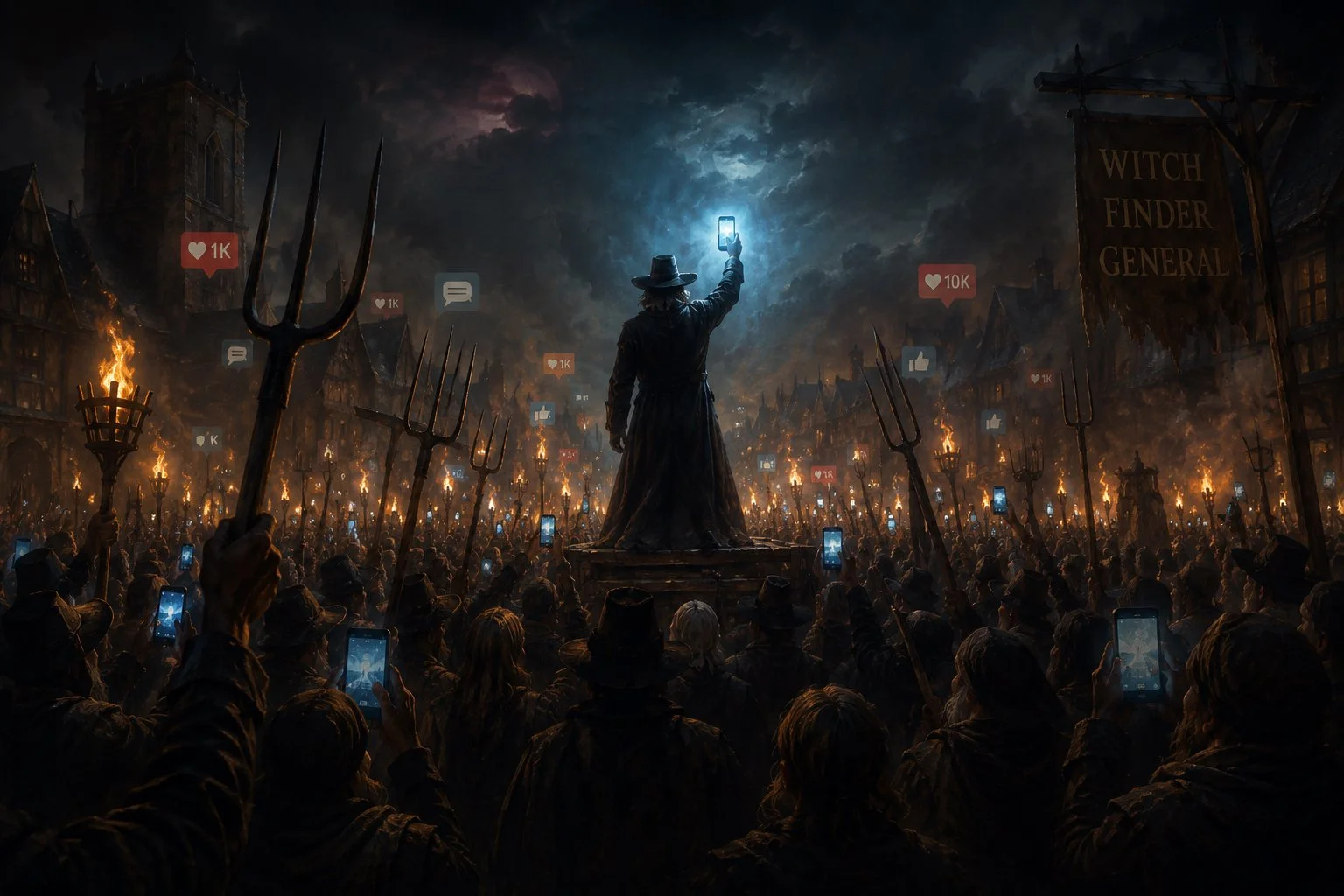
There is a video on YouTube right now that has been received, in most quarters, as a victory. A bass player with a significant following spent what he describes as hours forensically hunting down evidence that a woman with a growing social media presence had been miming to AI generated music. He found it. He made a video about it. The comments filled up with congratulations. Nice work. Another one exposed. The community is safer now.
Something about that conclusion doesn't sit right with me.
Not because what she did was fine. Miming to AI generated music and presenting it as your own performance is a form of deception and it's worth saying so plainly. But because the response to it reveals something about the state of the online music community that deserves more examination than it's currently getting. When we cheer the exposure, we skip past the more uncomfortable questions. Who actually got hurt here? What was the motivation behind the hunt? And what does it tell us that the exposé performed just as well algorithmically as the original deception it was exposing?
Those are the questions worth sitting with.
The Witchfinder General and His Horde
In 17th century England, a man named Matthew Hopkins appointed himself Witchfinder General and travelled from village to village identifying witches for a fee. He was extremely good at his job in the narrow sense that he found witches everywhere he looked. He was also, by any reasonable modern assessment, doing enormous damage to the communities he claimed to be protecting. The people he accused were largely powerless. The crowds that gathered to watch were certain of their own righteousness. And Hopkins himself was being paid for every conviction.
The parallel to certain corners of YouTube is uncomfortable enough to be worth naming directly.
The exposure format has become its own genre, its own economy, its own performance. Someone with an audience identifies someone with less of one, builds a case against them, presents it with the appropriate mixture of reluctance and righteous satisfaction, and harvests the engagement that follows. The comments fill with people who have found their villain for the day. The accused gets mobbed. The exposer gains subscribers. Everyone feels they have participated in something just.
And somewhere in all of that the actual music gets forgotten entirely.
Both Transactions. Neither A Transmission.
Here is what strikes me most about the specific case that prompted this post. Both parties were after exactly the same thing. Views. Recognition. An audience. The woman miming to AI music wanted the algorithm to reward her. The man who spent hours hunting her down wanted the algorithm to reward him. One chose deception as the method. The other chose exposure. But the underlying motivation, the chasing of attention and the commercial reward that follows it, was identical in both cases.
This is what I mean when I talk about transmission versus transaction. A transmission is something made because it needs to exist, because you have something genuine to say and the act of saying it is its own justification. A transaction is something manufactured to extract a return. Both of these activities were transactions dressed up as something nobler. One as authentic musicianship. The other as truth and justice.
Neither was the real thing.
The Proportionality Problem
It is worth asking, plainly and without flinching, what actual harm was done by the original deception. A woman posted videos online miming to AI generated music. She gained an audience. Some well known musicians liked and followed her content and felt embarrassed when the truth emerged. She earned some YouTube advertising revenue she arguably hadn't been fully honest about.
That is the complete inventory of the damage.
Nobody lost their livelihood. Nobody was defrauded of money they chose to spend. Nobody was imprisoned or humiliated before a crowd or denied anything they were owed. She made some videos, she was less than fully honest about how they were made, and she got some views.
Now consider what the exposure video actually set in motion. A comment section full of people flooding onto her channel to tell her she is fake and despicable. The exposer pre-emptively asking people to be respectful while knowing perfectly well what comment sections do when handed a target. A community that was already fracturing along lines of AI anxiety and authenticity anxiety given another reason to turn on itself. And suspicion, once applied broadly enough, colours how people approach the next musician they encounter online.
The cure did more damage than the disease. That is not a small thing.
The White Witch Problem
There is another layer to this that the exposure format is structurally incapable of addressing because nuance doesn't perform well in comment sections.
AI as a tool is not inherently good or bad. The ethics of any tool depend entirely on how it is used. Someone using AI to genuinely augment a creative process they control, to generate a texture, to explore a sound, to iterate on an idea, is doing something categorically different from someone miming to AI output and presenting it as live performance. But the Witchfinder General cannot make that distinction. The horde certainly cannot. Once the tool has been declared suspect, everyone who touches it is tarnished by the same association regardless of what they are actually doing with it.
Think about the village healers who knew which plants reduced a fever and which ones didn't. Some of what they knew was superstition. Some of it was genuinely useful knowledge that predated the formal medical apparatus by centuries. The witch hunt could not distinguish between the herbalist who was helping people and the one who wasn't, because the hunt was never really about the herbs. It was about fear, and control, and the very human desire to locate a clear enemy and feel righteous about opposing them.
The blanket condemnation of AI in music is doing something similar. It is making it harder, not easier, to have the genuinely important conversations about when and how these tools are being used responsibly, because the conversation has been poisoned by the same fear and the same need for a clear villain that always drives a witch hunt.
What The Community Could Be Instead
The online music community is full of people who genuinely love music. Who make it seriously and share it honestly and care deeply about its future. That is real and it matters and it deserves better than the exposure economy that is currently eating a significant portion of its attention and energy.
Every hour spent forensically hunting down a pitch shifted blues clip is an hour not spent writing something. Every exposure video is an opportunity cost measured in songs that didn't get made. Every comment section pile on is a conversation about music that didn't happen. The Witchfinder General is always busy. The question is whether being busy is the same as doing something useful.
The woman at the centre of this particular story can actually play. The video that set off the whole chain of events contains, buried within it, footage of her playing guitar and talking to a camera and sounding genuinely good. She didn't need the shortcut. Something about the platform, its incentives, its rewards, its metrics, led her to take one anyway. That is the more interesting story. Not the gotcha. Not the exposure. The fact that a platform can take someone with real ability and real music to offer and convince them that the AI version will perform better.
That is what is actually broken. Not her. Not him. The machine they are both feeding.
The Witchfinder General has a YouTube channel, a merch store, and a comment section ready to do his work for him. The witches he finds are real enough in their small deceptions. But the hunt is doing more damage to the village than the witches ever did.
Put down the torches. Pick up the instruments. Make the thing that needed making.
That's the whole vocation.