The Only Real Reason To Make Music Anymore
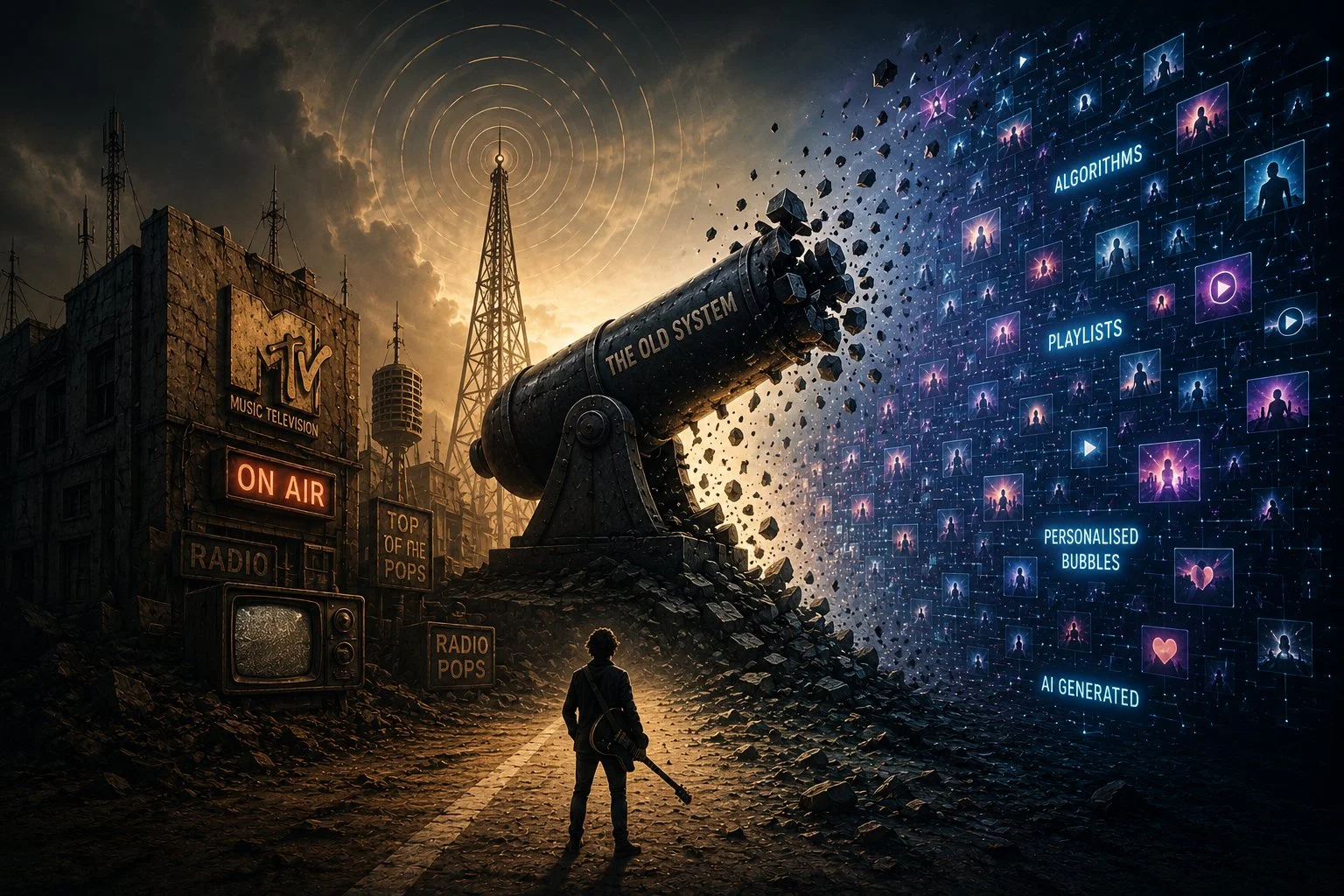
There is no money left in music. Not for most people, not in any reliable or meaningful sense. And the sooner we stop pretending otherwise, the sooner we can ask the question that actually matters: why are you making it at all?
The commercial music pipeline has collapsed at both ends simultaneously. The economics are broken, streaming pays artists so little that a living wage from music alone is effectively a lottery win for all but a handful of people. And the discovery mechanism is broken too, the broadcast cannon that once fired artists into the collective consciousness of millions no longer exists in any reliable form. If the only reason you are making music is commercial success, the hard truth is that you are probably going to fail. Not because you aren't good enough. Because the pipeline itself is gone.
So let's talk about what actually happened, and what's left on the other side of it.
Think about what the old system actually was. Radio came first, the original cannon, firing artists into living rooms and car journeys and workplaces simultaneously, creating shared cultural moments at scale. Then MTV arrived in the 80s and turbocharged everything, adding a visual dimension that could make a band famous overnight. Combined with television moments like Top of the Pops, Later with Jools Holland, Letterman, and SNL, you had an interlocking system of broadcast cannons that could fire an artist directly into the collective consciousness of millions of people simultaneously.
We tend to remember these as discovery mechanisms, places where great artists were found and celebrated. But that's not really what they were. They were managed injection points. A small number of powerful gatekeepers decided what millions of people would be exposed to, whether those people asked for it or not. The system was never a meritocracy. But at least the mechanism was visible, and it worked reliably enough that a global industry could be built around the expectation of it producing stars.
Then MTV made a decision that tells you everything about what the industry was actually built on. It voluntarily walked away from music and pivoted to reality television because reality TV was more profitable. One of the most powerful music delivery mechanisms ever built abandoned music entirely because the money was better elsewhere. That's not a small detail. That's a signal.
What replaced the old system isn't democratised discovery. It's ten million personalised bubbles all firing in different directions simultaneously, each one algorithmically reinforcing what you already like, none of them creating shared cultural moments anymore. The cannon is gone. And what replaced it pretends to be organic and meritocratic while actually running the same corruption in less visible ways. Playlist placement. Stream farming. Algorithmic gaming. Same palm greasing, democratic costume.
YouTube deserves acknowledgement here because it's the closest thing the modern era has produced to a genuine alternative delivery mechanism. Creators have built substantial audiences through consistency, quality, and genuine connection over years. This is real and it matters. But YouTube is a fundamentally different kind of cannon. It doesn't fire you into anyone's consciousness. It rewards people who find you, one at a time, over a long period, provided you're offering something genuinely differentiated. It's a slower mechanism with a lower ceiling, and it still requires time, consistency, and production investment that isn't nothing.
The runway argument you hear a lot, that most people can't afford enough time to become exceptional, is largely right. But it needs reframing slightly. The problem isn't just that most people can't afford enough time to become exceptional. It's that even exceptional people, fully formed and making genuinely great work, can disappear without trace because the mechanism that would have once fired them into public consciousness no longer exists in any reliable form.
Here's the thing that reframes this entire conversation.
We keep talking about the music industry as though it's a permanent fixture of human civilisation that's currently under threat. It isn't. It's a historical anomaly that lasted roughly one human lifetime and we're probably watching it end.
Commercial recorded music is approximately 120 years old. The first shellac records sold around 1900. The vinyl LP arrived in 1948. Rock and roll, the Beatles, FM radio, and the album era drove a genuine explosion through the 60s. The real golden age, where major labels printed money, artists became fabulously wealthy, and the whole edifice seemed permanent and inevitable, lasted from roughly 1970 to 1999. Thirty years. One human lifetime.
Before that, for the entirety of human history, musicians were court composers dependent on aristocratic patronage, pub entertainers tipped by their audience, travelling performers, skilled craftsmen for hire. Beethoven wasn't a rock star. He was a talented employee keeping wealthy patrons happy. Bach wrote a new cantata every week because his employer required it. Mozart died in debt. The idea that music is a product you sell to a mass market is not an ancient truth. It's a very recent commercial experiment.
Then Napster arrived in 1999 and broke the psychology of music as something worth paying for. The industry sued its own customers, failed to adapt fast enough, and eventually capitulated to streaming platforms on terms so unfavourable to artists that the price per stream is effectively insulting. Ten dollars a month for access to every song ever recorded. The film industry never accepted this logic. But music blinked, and artists are still paying the price for that capitulation.
And now AI has arrived to complete the disruption. Companies have hoovered up decades of recorded music to train models that can generate passable music on demand from a text prompt. The human creator is increasingly optional in the commercial equation. Every layer of this, Napster, streaming, AI, has transferred more power to platforms and less to the people who actually make the work.
So when we ask whether most people can be commercially successful in music, we may be asking the wrong question entirely. The more honest question is whether the commercial music industry, as we have known and romanticised it, is terminal. And I think the answer is probably yes, at least in its current form.
Which brings us to the only question that actually matters.
For most of human history, musicians made music because they were compelled to. Because a community needed them. Because a patron paid them enough to survive. Or simply because the act of making it was its own reward. Commercial superstardom is the anomaly, not the baseline.
If the commercial pipeline is broken beyond repair, and I increasingly think it is, then the question shifts from how do most people achieve commercial success to something older and more honest: how do you make meaningful work, find the people it's for, and sustain yourself well enough to keep making it.
That's not a lesser ambition. It might actually be the truer one.
The only real reason to make music anymore is because you love making it and have something to say. Because the work itself matters to you regardless of what it returns commercially. Because somewhere out there is a person who needs to hear exactly what you made, and the act of getting it to them is its own complete justification.
That's what's left. And honestly, it's what was always there underneath the industry machinery. The machinery just made it easy to forget for a while.
The industry as a commercial pipeline for new talent is probably not fixable. But music itself is not going anywhere. It’s here to stay.