Modern Living - Compliance Theatre
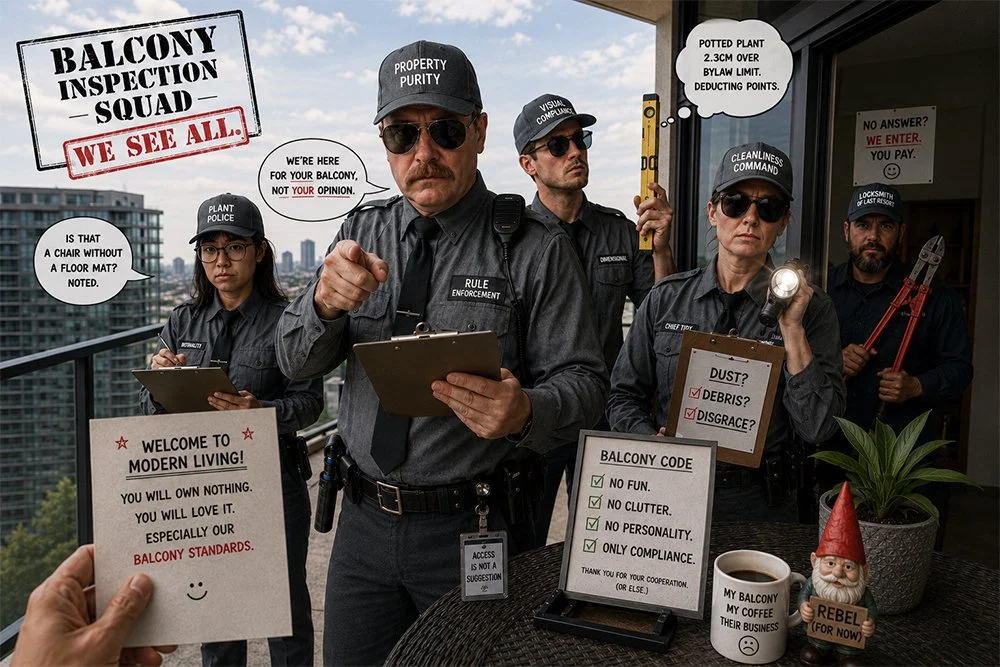
There is a particular kind of absurdity that only modern institutional living can produce. Last week I received a notice. A formal, official, portentous notice. My balcony was to be inspected. Not suggested. Not requested. Inspected. By a team. With clipboards. On a Saturday.
The notice was clear about the stakes. If I did not respond, they would enter anyway. If they needed a locksmith, I would pay for it. The corporation had standards. The corporation had bylaws. The corporation, it turns out, had an awful lot of opinions about my balcony.
What the corporation did not have, as it turned out, was a working chiller. Or reliable water. Or furniture that wasn't installed sometime around the peak of the first Obama administration. But those are different departments presumably.
Let me tell you what was on the inspection checklist. Balcony cleanliness. Railing condition. Items stored on the balcony. General tidiness. A formal audit of whether I, a grown adult paying a significant monthly sum to live twelve floors above street level, had left anything unsightly on a platform of concrete that I cannot actually use because the smell from below makes it uninhabitable. That last part was not on the checklist.
Here is what else was not on the checklist.
The heating system that ran into summer because it shares a loop with the domestic hot water. Not a design choice anyone was willing to revisit. Just a fact of life, apparently.
Temperatures hitting 27 to 29 degrees Celsius. Weeks of it. When I reported it, I was told it was probably my lamps. I turned every lamp off and monitored the temperature overnight. It made no meaningful difference, which will surprise nobody who passed basic physics. The next explanation, for the lobby temperature of 29 degrees Celsius, was solar gain from the south-facing lobby glass. At seven in the morning. Before the sun had any meaningful angle on the building.
The zone valve that was replaced a month before. The one that was supposed to fix the heat problem. The one that moved the temperature approximately two degrees in the right direction and was never mentioned again.
The chiller that sat untested until the moment it was needed, was found to be broken, and has been in a queue for repair ever since. Summer did not arrive unexpectedly. It does this every year. At the time of writing the chiller is still offline.
The water that gets turned off almost once a month. Not a burst pipe emergency. Not a one-off fix. A rolling infrastructure project to retrofit each floor with independent water isolation, executed one floor at a time, month after month, with residents given notice and expected to simply accommodate it. A job that could have been planned and completed as a single coordinated effort, apparently being absorbed into the background hum of living here instead.
The dishwasher fascia held together with gaffer tape. The gas ring producing flames at a height that could generously be described as ambitious and less generously described as a fire hazard.
Many years of tenancy. No proactive maintenance check. Not one.
But there was, during the worst of the overheating, a building-wide email about cigarette butts on patios. That got written. That got sent. Priorities intact.
This is not one building's problem. This is not even a property management problem, though property management is certainly doing its part to keep the tradition alive. This is a pattern so embedded in modern institutional life that most people have simply stopped noticing it. The energy always flows in one direction. Downward. Toward the tenant, the resident, the customer, the citizen. Never upward toward the institution, the corporation, the board, the operator.
The rules exist for you. The accountability does not extend to them.
Every person who has ever rented an apartment, owned a condo, lived in a managed building, or dealt with any institution that holds structural power over their daily life knows this dynamic. The lease is forty pages of your obligations. Their obligations fit in a paragraph and come with enough qualifications to render them essentially decorative. You must pay on time, maintain the unit, comply with bylaws, accommodate inspections, and submit requests through the proper channels. They must make reasonable efforts, within a reasonable timeframe, subject to reasonable interpretation of what reasonable means, which they get to define.
The inspection is the purest expression of this inversion. It requires you to be available, to comply, to accommodate strangers walking through your home on a Saturday morning. It requires them to show up with a clipboard and tick some boxes. The power relationship in that transaction could not be clearer if it came with a diagram.
What never gets inspected is whether the building is doing its job. Whether the systems work. Whether the environment is actually habitable. Whether the people living there are getting what they are paying for. That inspection does not exist. There is no clipboard for it. There is no team. There is no Saturday morning set aside for it. There is just a request portal, a response window measured in weeks, and a series of explanations about why the problem is more complicated than you understand.
The cigarette butt email is not an accident. It is the system working exactly as designed. Visible, low-cost enforcement of tenant behaviour. Invisible, high-cost avoidance of institutional accountability. Clean metrics. Tidy records. Nothing that requires anyone to actually fix anything.
There is a word for this. It is called compliance theatre. The performance of accountability without the substance of it. The inspection that protects the institution's liability while doing nothing for the person living there. The notice of entry that arrives with the full weight of bylaws and locksmith threats behind it, for a balcony. The request portal that exists not to resolve problems but to document that problems were received, which is a different thing entirely.
The people running these systems are not necessarily malicious. That is almost the more unsettling part. The system does not require malice to function this way. It requires only that accountability flows in the direction of least resistance, which is always downward, and that the metrics measure what is easy to measure rather than what actually matters. Ticked boxes. Submitted requests. Notices sent. Inspections conducted. All of it logged. None of it pointed at the right problem.
If you have ever sat in an apartment that is 29 degrees in summer because a building system has failed, waiting for someone to tell you it is probably your lamps, you already know this. If you have ever submitted a maintenance request and received an explanation instead of a repair, you already know this. If you have ever been handed a forty page lease and told to sign it, you already know this.
The balcony inspection team will come. They will check the railing. They will note the cleanliness. They will tick their boxes and leave. The chiller will remain offline. The water will go off again next month. The gaffer tape will hold the fascia together for another season. But the balcony will have been inspected. Standards maintained. The system, as far as the system is concerned, is working perfectly.
The irony in all this is that their inspection window passed. But no one came. I called to find out what was happening. They said they were running late. Literally minutes later a young guy arrived at my door to perform the inspection. He checked the balcony, which took approximately two minutes. He spotted my keyboards, asked if I made music, turns out he makes music too. We had a chat. The balcony passed. Standards maintained.