I Accidentally Started an AI Punk Band
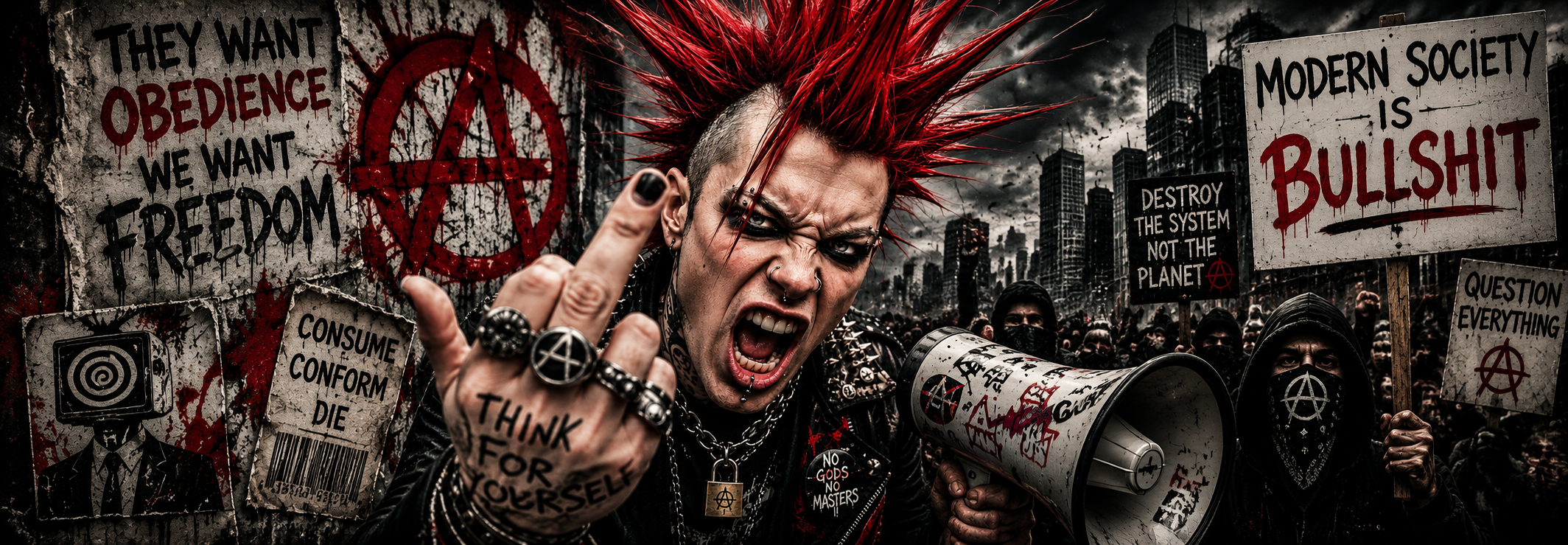
I want to be clear about something from the start. This is not a post about AI music. Or rather, it is, but only in the same way that a post about a hammer is really about the nail.
The tool is not the story. The tool is never the story.
It started with annoyance. Not inspiration. Not a creative vision. Not a carefully considered artistic decision. Just annoyance.
The building I live in had shut the water off again. A YouTuber I'd been following had posted a video calling for his audience to pile on a named individual because she'd been miming to AI-generated music, smiling as he did it. Work had been a particular kind of exhausting. The systems around me felt simultaneously broken and aggressively defended by the people most responsible for breaking them.
So I opened Suno and started writing punk lyrics on my couch.
I wasn't thinking about AI. I wasn't thinking about music theory or production or distribution or audience. I was thinking about condo boards issuing violation notices about potted plants while the elevator sat broken for the third week running. I was thinking about work. I was thinking about a Youtuber calling himself a defender of authentic music while monetizing outrage.
I wrote one song. Then another. Then I couldn't stop.
By the end of the afternoon I had seven tracks, a visual identity, a recurring mascot, and a coherent aesthetic universe.
I had accidentally started an AI punk band.
The band is called Popcorn and Apples. The name comes from what I was eating, because I'm managing my cholesterol and punk rock is apparently compatible with heart-healthy snacking. This is the most punk origin story I can think of.
Here's the thing that surprised me, and the reason this post exists. At no point during that afternoon was I thinking about the AI. Not once. I was thinking about the condo board. I was thinking about the YouTuber. I was thinking about systems that perpetuate their own dysfunction because the people running them profit from the dysfunction. I was thinking about what it means when accusation becomes a product, when outrage becomes a revenue stream, when the performance of caring replaces the act of caring.
The AI was just the cheap Telecaster. Three chords and something to say.
Here's the position I actually hold, which seems to be rarer than it should be.
I don't think AI is the future of music. I don't think AI is destroying music. I don't think the tool is particularly interesting either way. What I think is this: I had ideas. The ideas existed before I opened Suno. The frustration existed before I opened Suno. The things I wanted to say about broken systems and transactional relationships and YouTube witch hunts existed before I opened Suno. The tool just lowered the barrier enough that the ideas got out.
That's it. That's the whole argument.
The message was already there. The tool gave it a voice. If I'd had a garage and a drummer and three hours to spare, maybe it would have been a different kind of voice. But the message would have been the same, because the message is the thing. The message is always the thing. It has to be, otherwise why are you making anything at all?
There's a YouTuber currently building a brand around the idea that AI-generated music is inherently fraudulent, that the tool contaminates the message. His band has 201 monthly listeners on Spotify. His channel has significantly more. Make of that what you will.
The artwork surprised me too.
I generated images for each track, and what came back wasn't generic. It was coherent. A recurring figure started appearing across all seven pieces: a red-haired punk with an anarchy symbol on his jacket, always standing with his back to the viewer, facing the thing he's up against. The condo board inspectors. The throne built from Jira boards and KPI dashboards. The Witchfinder General on his pulpit with a ring light halo and a mob holding torches and smartphones.
I didn't plan the recurring figure. It emerged from the consistency of the prompts, which emerged from the consistency of the ideas underneath them. The message organized the aesthetics, not the other way around. The thing had a visual identity because it had something to say, not because I designed a visual identity.
That felt important.
Then I started thinking about discoverability, as I always do eventually, because it's the part of being an independent artist in 2026 that nobody has actually solved.
And I realised something.
Popcorn and Apples has a discoverability problem. Vintage Sound Project has a discoverability problem. Every artist on Bandcamp has a discoverability problem. Every artist on SoundCloud has a discoverability problem. The platforms are full. The feeds are full. The algorithms are optimized for retention, not discovery. The bottleneck isn't creation anymore. Anyone can create. The bottleneck is attention, and attention is the scarcest resource on the planet.
Which is, I noticed, exactly what several of the songs are about.
They Keep It Broken is about systems designed to extract attention and convert it into profit. Witchfinder General is about someone who monetized the attention economy's outrage loop. Cash Injected is about the people who own the infrastructure that attention runs through. The whole project accidentally ate its own tail. I made seven songs about the broken attention economy on a platform that is part of the broken attention economy, and then started worrying about whether anyone would notice.
That's either a contradiction or it's punk. Possibly both.
I didn't go into that Sunday looking for a lesson. I went in annoyed, with popcorn and an apple, looking for somewhere to put the frustration that wasn't a passive aggressive email or a comment section argument.
What I came out with was this: the message matters more than the tool. It always has. It always will. The artists who last are the ones who had something to say, not the ones who had the best instrument or the most sophisticated production or the most optimized distribution strategy. The thing has to exist because of the message. Nothing else is a good enough reason.
Popcorn and Apples exists because I was annoyed about real things. The broken building. The broken workplace. The broken political system. The broken culture of online accountability that looks suspiciously like a different kind of broken. Those are real frustrations and they produced real songs, and the fact that a piece of software helped me make them doesn't make the frustration less real or the songs less mine.
The tool made the message audible. The message was already there.
It was always going to come out eventually. On a Sunday afternoon, apparently, with seven punk songs and a bowl of popcorn.
Popcorn and Apples is available on Suno. Broadcasting from outside the system. Truth, three chords and catchy hooks.