Eleven Lights
Released On October 2nd 2026
Look up at the night sky and almost everything you see belongs to our Milky Way galaxy. Yet the points of light scattered across it are separated by distances that are difficult to comprehend. Some are relatively close neighbours. Others are so remote that the light reaching us tonight began its journey thousands of years ago.
Eleven Lights takes its name from eleven of those stars.
Eleven Lights begins close to home and travels steadily outward into the Milky Way galaxy. The journey starts with Barnard’s Star, one of our nearest stellar neighbours at less than six light-years away. From there, each track carries us farther into the darkness, through Procyon, Vega, Arcturus, Castor, Aldebaran, Alphard, Mira, Antares and Rigel, before finally arriving at Deneb, whose blue-white light reaches us from thousands of light-years away.
What appears from Earth as a collection of simple points of light becomes considerably stranger when each is considered individually. Barnard’s Star is a small red dwarf accompanied by tiny worlds. Procyon contains a white dwarf orbiting a much brighter star. Vega is surrounded by an enormous disk of debris. Castor, seemingly a single star to the unaided eye, is actually a gravitational system of six stars. Mira races through interstellar space trailing material across light-years, while Antares possesses an atmosphere extending many times beyond its already enormous visible surface.
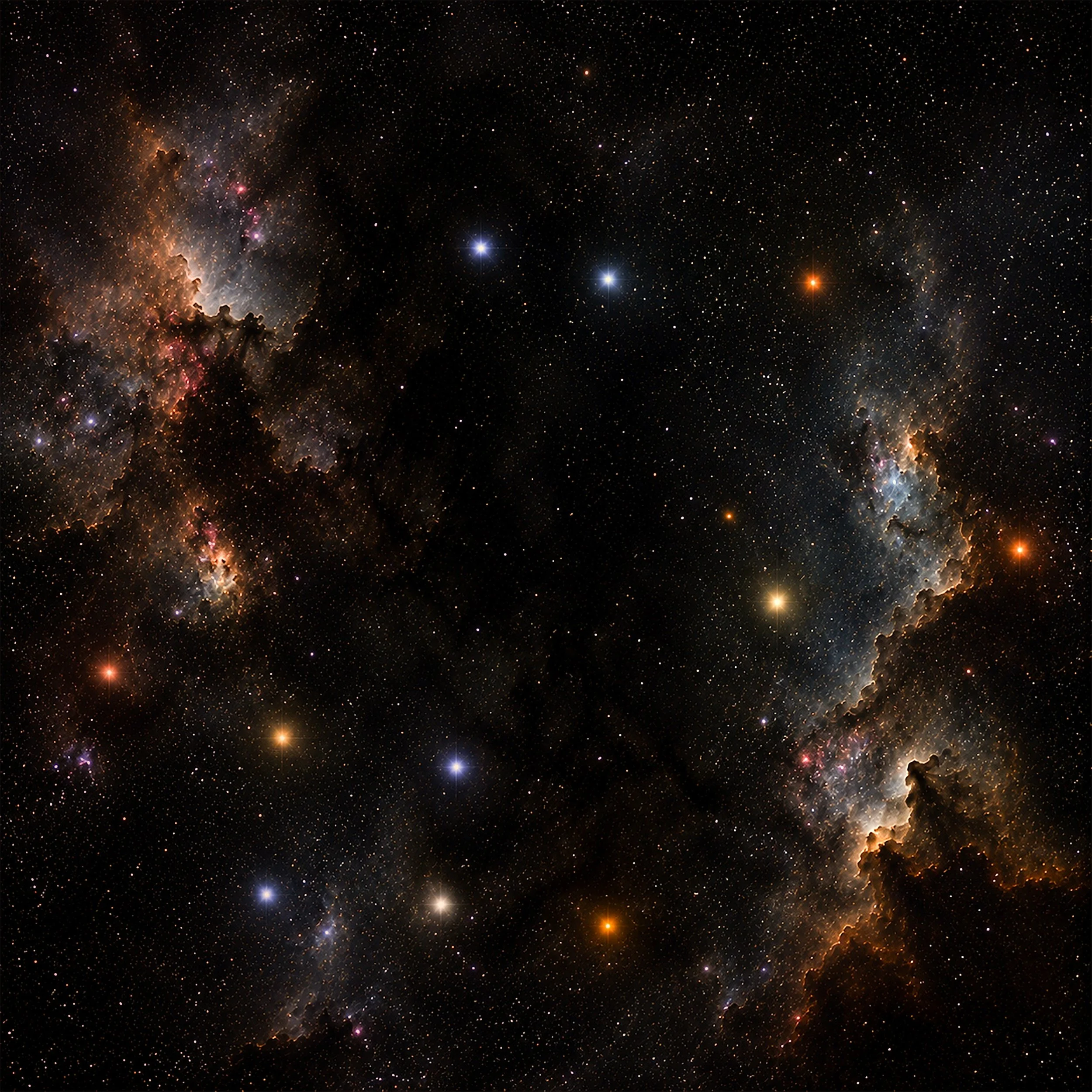
The eleven principal stars visible on the album artwork are plotted from their real positions in the night sky using an azimuthal equidistant projection, bringing the astronomical journey at the heart of the album into the artwork itself.
The images of the individual star systems below are artistic visualizations based on astronomical facts about each system to give an idea of just how different each one is.
Taken together, these eleven stars are a reminder that the familiar points scattered across our night sky are not interchangeable lights pinned to a distant ceiling. Each is a place with its own scale, history and physical character. Some are small and ancient. Some exist in elaborate families. Some are approaching the final stages of stellar evolution. Some illuminate their surroundings, while others are actively throwing parts of themselves back into space.
And all we see from here is the light.
Barnard’s Star

The track evokes something ancient and wandering, moving quietly through the darkness.
Barnard’s Star is one of our nearest stellar neighbours, lying just under six light-years from the Sun. It is a small, old red dwarf, far cooler and dimmer than our own star. Despite its modest appearance, it has one of the most remarkable planetary systems in the solar neighbourhood. Four tiny planets have been detected orbiting extremely close to the star, with masses between about 19 and 34 percent that of Earth. All four complete an orbit in less than seven Earth days.
The image imagines a view from the surface of one of these small worlds, with Barnard’s Star looming red-orange above a barren landscape. The precise appearance of the planet is unknown, so the landscape is necessarily an artistic interpretation. What is known is that these worlds orbit so close to their star that they are expected to be too hot for liquid water on their surfaces. From such a close orbit, this otherwise faint little red dwarf would dominate the sky.
Procyon

The track evokes two distinct presences moving slowly together, reflecting the contrasting stars of this binary system.
At about 11.5 light-years away, Procyon is not a single star but a binary system. The brilliant Procyon A is an F-type star nearing the end of its main-sequence life and beginning its transition toward the subgiant stage. Beside it is Procyon B, a white dwarf: the compact remnant left behind after a star exhausted its nuclear fuel and shed its outer layers. The two stars orbit one another every 40.84 years.
That extraordinary contrast is what the image represents. Procyon A dominates as the large yellow-white source of light, while Procyon B appears as the much smaller, intensely hot point nearby. Their orbit is distinctly elliptical, so the distance separating the pair changes considerably over the course of each revolution. Procyon B may be visually insignificant beside its brilliant companion, but it is the remains of a star that once followed an entire stellar lifetime of its own.
Vega

The track evokes Vega’s vastness and luminosity, suspended within an immense and distant space.
Vega lies about 25 light-years from Earth and is one of the brightest stars in our night sky. But the star itself is only part of the story. Surrounding Vega is an enormous disk of dust and debris, first revealed through the excess infrared radiation coming from the system and now studied in remarkable detail by both the Hubble and James Webb space telescopes. Recent observations show a disk almost 100 billion miles across.
The image takes us inside that system, viewing Vega through the surrounding debris rather than from Earth’s nearly face-on perspective. In reality the disk is surprisingly smooth, with fine dust extending across an enormous area and no obvious signs of massive planets carving their way through it. Webb has resolved both warm material closer to Vega and a vast outer disk analogous in broad terms to our Solar System’s Kuiper Belt. The individual rocks and particles in the image are an artistic way of making that otherwise extraordinarily diffuse structure visible.
Arcturus
The track evokes the stately, almost regal presence of this evolved orange giant.
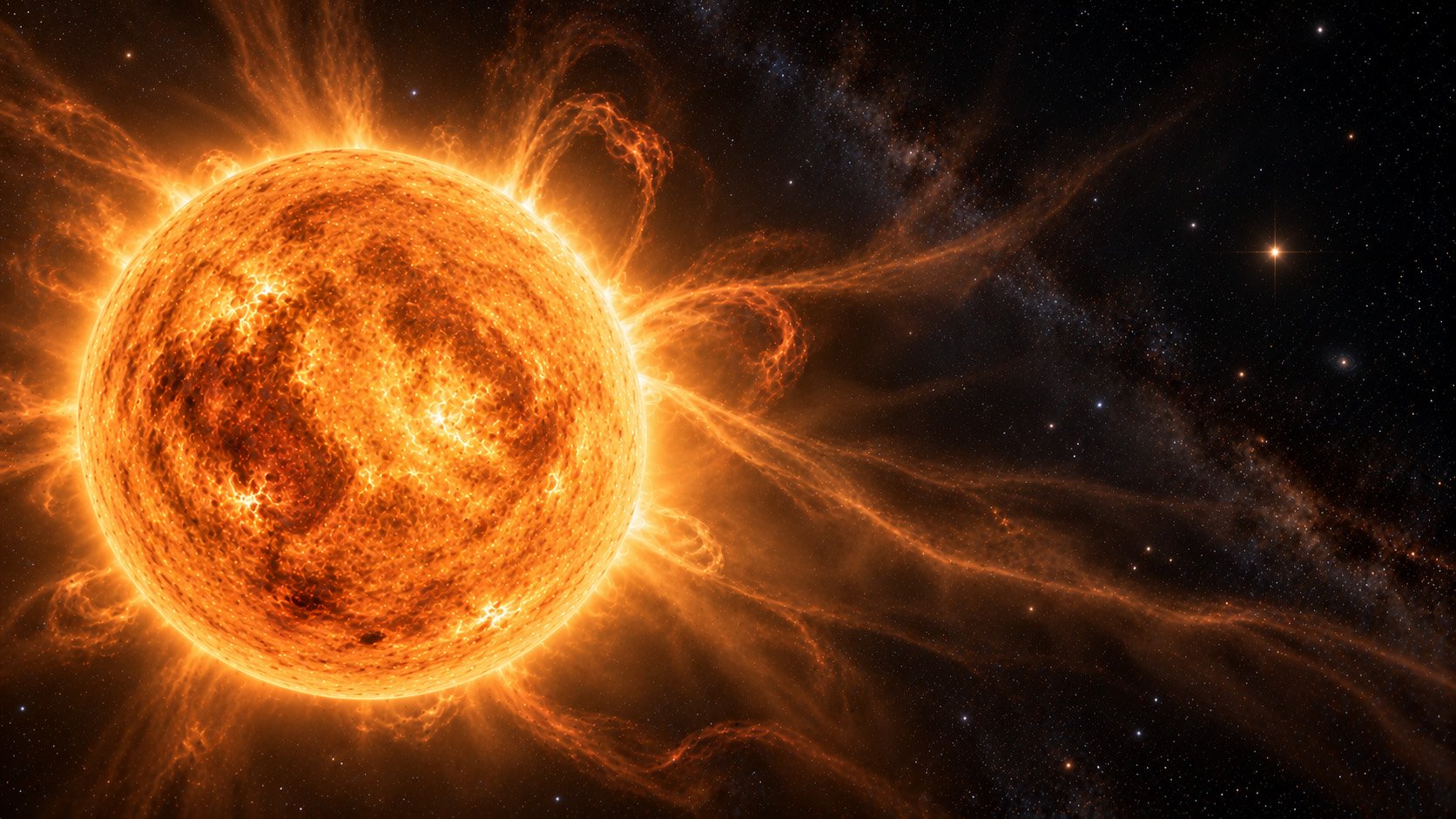
Arcturus is an orange giant about 37 light-years away. It began life much more like an ordinary main-sequence star, but after exhausting the hydrogen in its core it expanded into the enormous evolved star we see today. Its visible surface, however, is not a simple boundary between star and space. Observations have revealed cool molecular material extending surprisingly far above the photosphere.
The image visualizes that extended atmosphere. Interferometric observations have detected an inner carbon-monoxide layer immediately above the photosphere and another cool molecular component reaching approximately 2.6 times the star’s radius. Within this enormous region, Arcturus’s stellar wind begins to accelerate outward. The swirling material shown around the orange star is therefore not intended as a conventional nebula, but as an interpretation of a giant star whose atmosphere gradually gives way to an escaping stellar wind.
Castor

The track evokes multiple voices interacting and cascading around one another, reflecting the hidden complexity of this six-star system.
To the unaided eye, Castor appears to be a single bright star in Gemini. Arrive there, however, and the illusion falls apart spectacularly. Castor is a six-star system, arranged as three binary pairs, 51 light-years from the Earth. The two visually dominant components each contain a bright A-type star accompanied by a much fainter star, while the more distant system known as YY Gem consists of two cool red M dwarfs.
The image separates that hidden architecture so all three pairs can be understood at once. The two brilliant blue-white stars dominate the foreground, each accompanied by its much fainter partner, while the reddish YY Gem pair appears much farther away. YY Gem is itself remarkable: its two similar red dwarfs race around one another in only about 19 hours and eclipse each other as seen from Earth. What looks like one point of light in our sky is therefore an intricate gravitational arrangement of six individual suns.
Aldebaran

The track evokes the immense, imposing presence of a giant star, moving with a slow and deliberate grandeur.
Aldebaran is the great orange eye of Taurus, about 65 light-years from Earth. It is an evolved K-type giant, a star that has left its main-sequence life behind and expanded enormously as its internal source of energy has changed. Its warm orange colour immediately distinguishes it from hotter blue-white stars such as Vega, Rigel and Deneb.
The image brings us close enough to imagine the enormous convective structures moving across the surface of such an evolved giant. Those exact patterns cannot currently be observed on Aldebaran at this level of detail, so their appearance is an artistic interpretation of the turbulent outer layers of a giant star. Behind Aldebaran lies another familiar feature of the night sky: the Hyades. From Earth Aldebaran appears to belong to this V-shaped star cluster, but this is an illusion of perspective. Aldebaran is actually much closer to us and simply happens to lie along the same line of sight.
Alphard
The track evokes solitude and exploration, a lone presence wandering through an enormous expanse.
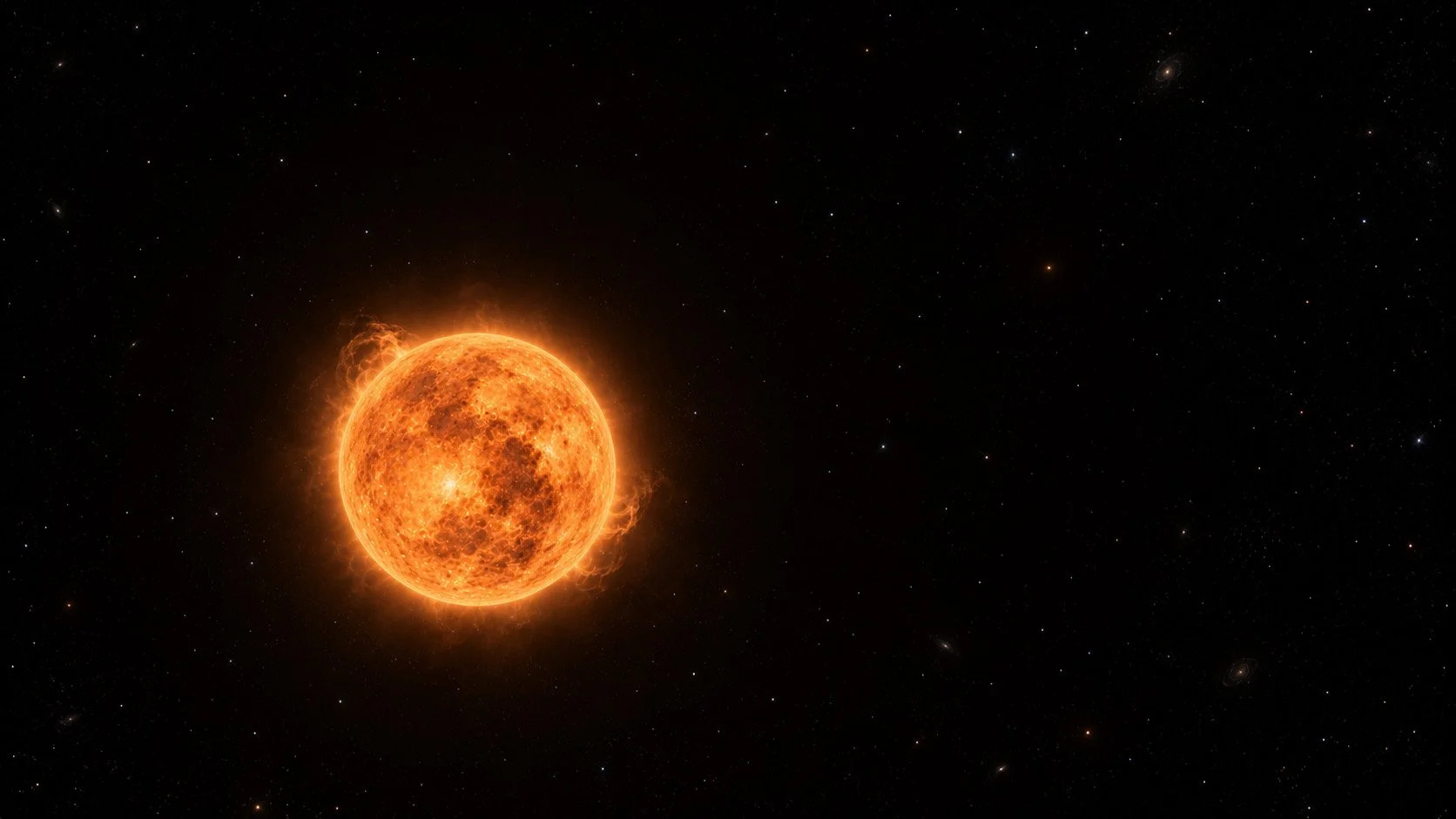
Alphard lies about 177 light-years away in Hydra. It is another evolved orange giant, but its most evocative characteristic is not something happening on or around the star. It is its apparent isolation. Its traditional Arabic name derives from a phrase meaning “the solitary one,” reflecting the way this bright star appears conspicuously alone in a relatively empty region of the night sky.
That isolation is the subject of the image. Rather than bringing the camera close to Alphard, the star has been allowed to occupy only a small part of an enormous expanse of space. The distant stars and galaxies scattered around it emphasize rather than diminish the emptiness. Alphard is not literally isolated from the rest of the Milky Way, of course. Its solitude is a feature of how we see it projected onto the sky from Earth. But among the faint stars of Hydra, its orange light stands conspicuously on its own.
Mira
The track evokes something beautiful but unstable, turbulent and constantly changing.
Mira is a swollen red giant roughly 350 light-years away in the constellation Cetus and the prototype of an entire family of pulsating variable stars. It dramatically brightens and fades over a cycle of about 332 days as conditions within the star change. Mira also has a white-dwarf companion, Mira B, with the pair taking roughly 500 years to orbit one another.
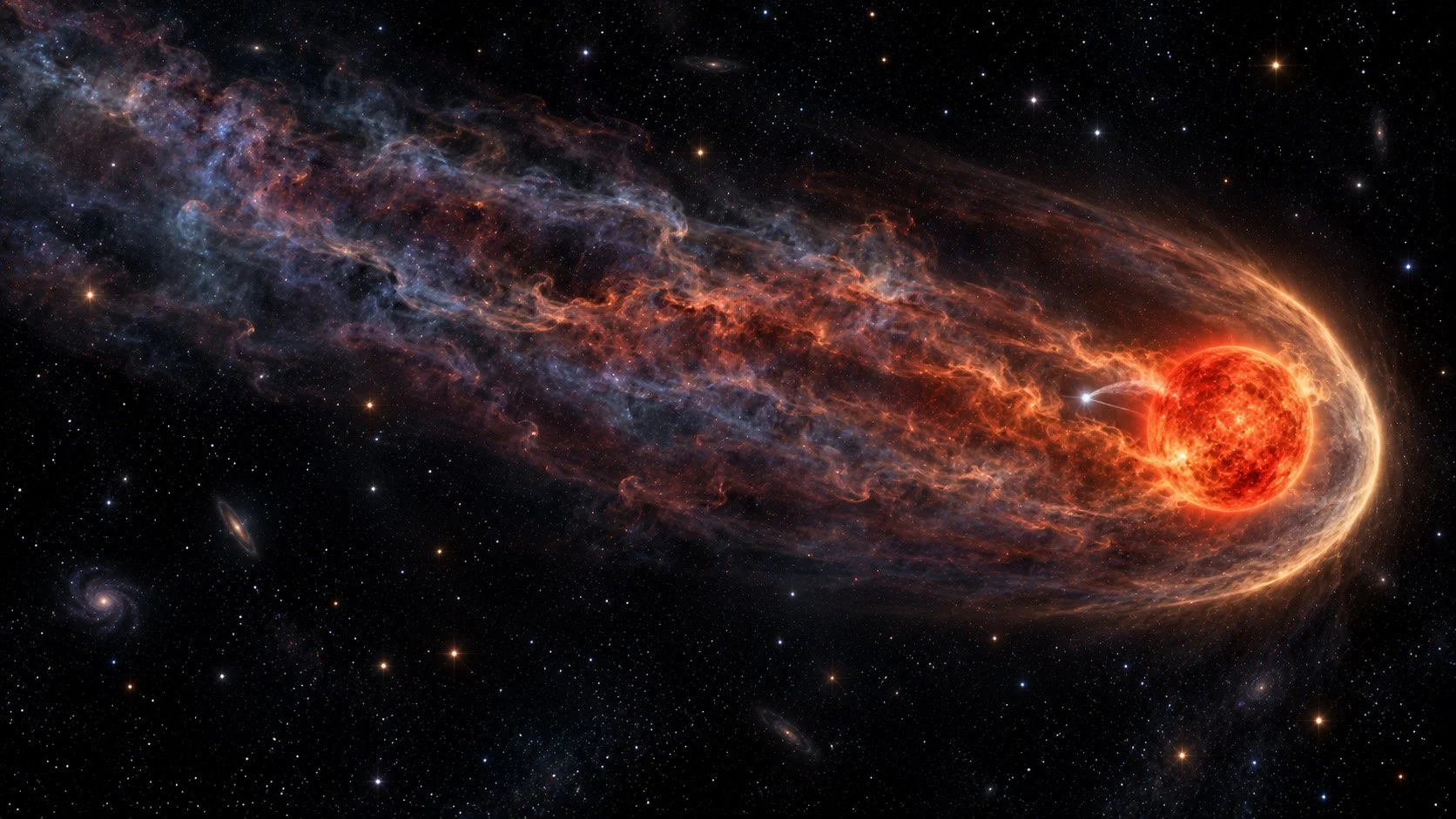
But the enormous structure in the image comes from another extraordinary property of Mira. The system is travelling through surrounding interstellar gas at around 130 kilometres per second while Mira A continually sheds material through its stellar wind. Gas piles up into a bow shock ahead of the moving star and streams backward into an immense turbulent wake. Observations by NASA’s GALEX spacecraft revealed that this comet-like tail extends for approximately 13 light-years.
The colours in the image visualize a phenomenon that is particularly prominent in ultraviolet light rather than showing exactly what human eyes would see. The enormous wake is composed of material Mira itself has cast into space, heated as the stellar wind interacts with the surrounding interstellar medium. The result is one of the most remarkable structures associated with any nearby evolved star: a red giant crossing the Galaxy while leaving light-years of its own material behind it.
Antares

The track evokes sheer scale and menace, a vast stellar presence that feels almost overwhelming.
Antares is a red supergiant in Scorpius, 550 light-years from the Earth, one of the truly enormous stars visible to the unaided eye. Its visible photosphere is roughly 700 times the diameter of the Sun. If Antares replaced the Sun at the centre of our Solar System, its visible surface would extend beyond the orbit of Mars. Yet even that enormous photosphere represents only part of the star’s true extent.
Radio observations with ALMA and the Very Large Array have traced Antares’s atmosphere to nearly 12 times the radius of the visible star. Its chromosphere alone extends to around 2.5 stellar radii, eventually giving way to a vast stellar wind carrying material away from the supergiant. This is the turbulent red-orange environment surrounding Antares in the image.
The tiny blue-white light beside the supergiant represents Antares B, its smaller but hotter companion. This companion does more than simply orbit Antares. Observations have revealed an enormous region of wind expelled by Antares A that is illuminated by Antares B. The contrasting blue glow in the image visualizes that interaction: a comparatively tiny hot star shining through material cast outward by one of the largest stars in our part of the Galaxy.
Rigel
The track evokes a luminous, dreamlike expanse, with movement continuing beneath an immense sense of space.
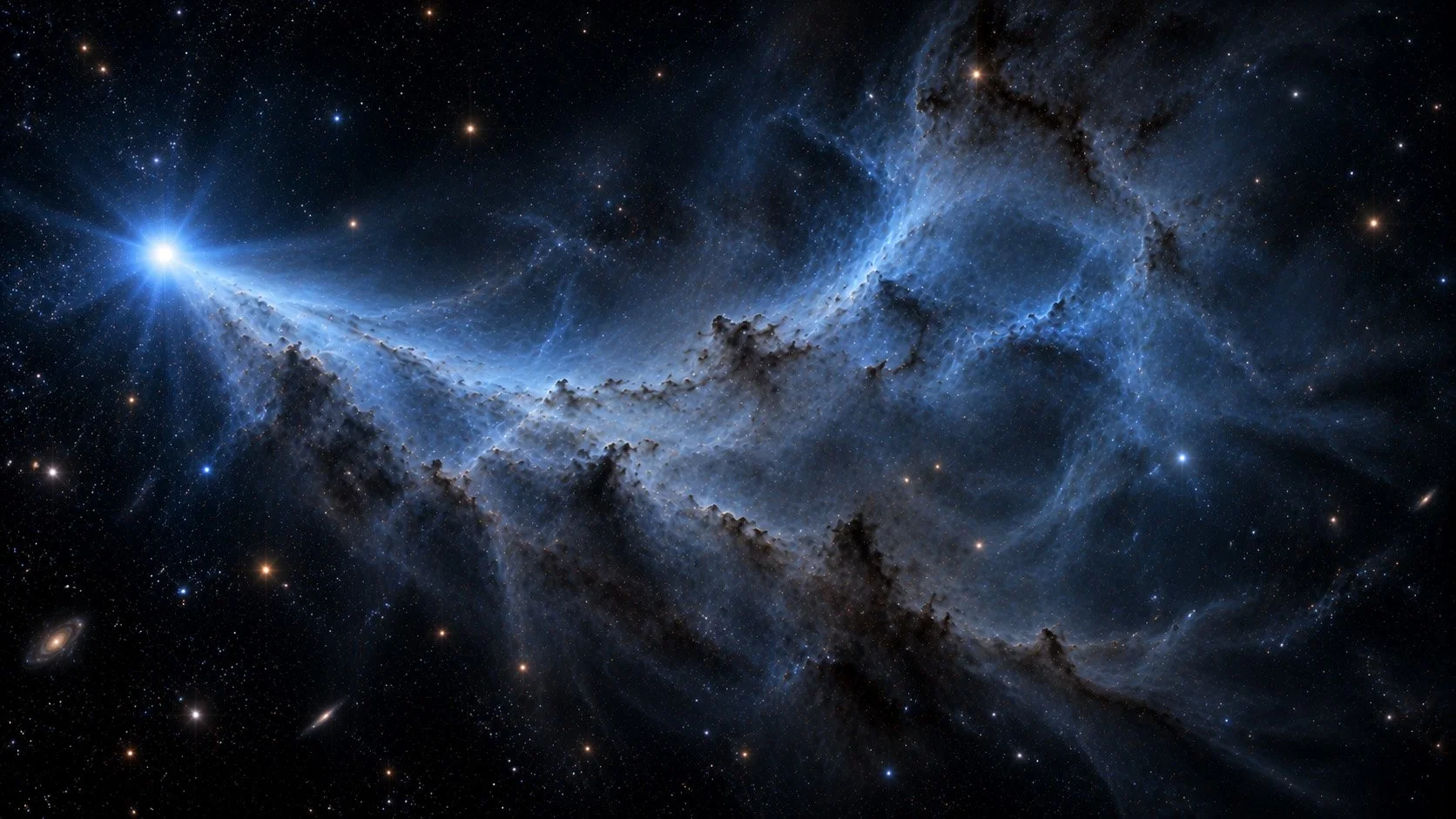
Rigel is the brilliant blue-white supergiant marking the foot of Orion, 860 light-years from the Earth. It is an extraordinarily luminous massive star, but in the accompanying image Rigel itself has deliberately been made relatively small. The enormous blue structure surrounding it tells another part of its story.
Nearby lies IC 2118, the Witch Head Nebula, an immense cloud of interstellar dust associated with Rigel. It is a reflection nebula, meaning the cloud does not produce the blue light seen in astronomical images by itself. Instead, fine particles of dust scatter the intense light arriving from Rigel, with blue wavelengths scattered particularly efficiently.
The image imagines the scene from a location in space rather than reproducing the familiar view from Earth. Consequently, the dust does not form the recognizable profile that earned IC 2118 its “Witch Head” name. Instead we see translucent layers, dark lanes and illuminated filaments extending through space, with Rigel blazing at their edge. The precise three-dimensional appearance is necessarily imagined, but the relationship at its heart is real: the cold blue light illuminating this enormous dusty environment comes from Rigel.
Deneb

The track evokes distance, suspension and wonder, a brilliant presence seemingly hanging in the depths of space.
Deneb is the final and most distant of the eleven stars, 2,600 light-years from the Earth, a blue-white supergiant in Cygnus. It forms one corner of the Summer Triangle with Vega and Altair and is among the most distant stars that can readily be seen with the unaided eye. The simple fact that Deneb appears so bright from such an extraordinary distance tells us something remarkable about the amount of energy it is releasing.
That is why the image is deliberately simpler than many of those preceding it. There is no invented planetary system or spectacular nebula required. Deneb is shown as an almost overwhelming blue-white beacon against the much fainter stellar background, its actual disk lost inside its own brilliance. The surrounding haze is only a restrained visualization of the environment around a massive supergiant rather than a claim that Deneb possesses a great visible nebula of its own.
After travelling outward from Barnard’s Star, less than six light-years away, the journey ends with a star so remote that its light has spent millennia crossing interstellar space before reaching us. Yet Deneb still shines prominently in Earth’s night sky.
Distance has done remarkably little to hide it.